

Art & Architecture
To learn more about St. John’s historic stained glass windows, please read or download Richard Grimmett’s The Historic Stained Glass Windows of St. John’s Church, Lafayette Square (PDF), which includes a map and list of all the windows on the main floor and gallery.
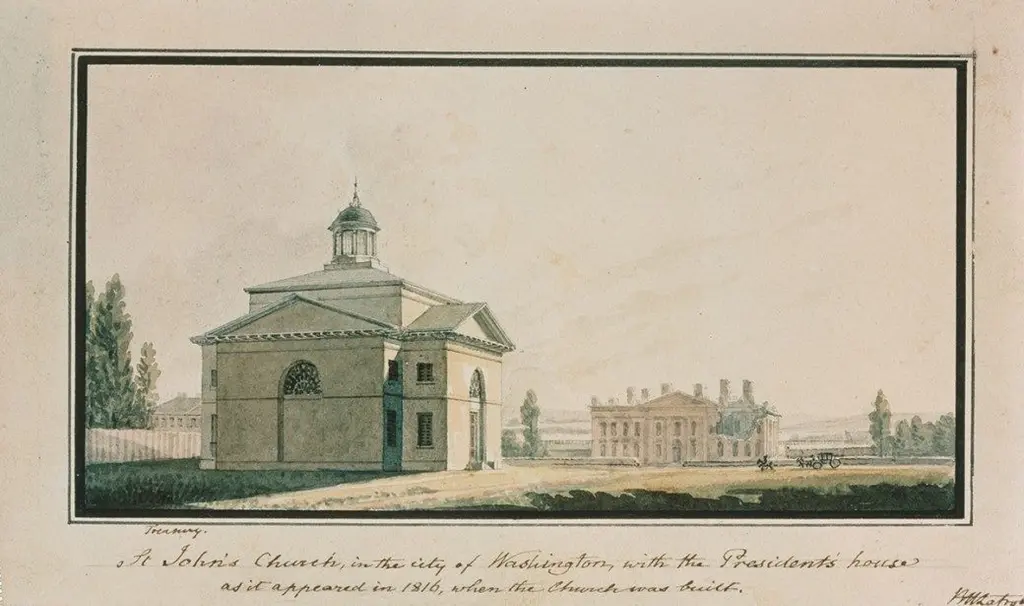
Watercolor of St. John’s Church by Benjamin Henry Latrobe
This drawing, made around 1816 by the architect Benjamin Henry Latrobe himself, shows St. John's Church viewed from the northwest, with the rebuilding President's House visible behind it to the south. The drawing was labeled by Latrobe as showing "St. John's Church in the city of Washington, with the President's house as it appeared in 1816, when the church was built," and the scene captures the burned-out President's House still under reconstruction after the War of 1812.
Latrobe took evident pride in his work. In a letter to his son that December, he wrote that the church "is a pretty thing, and has a celebrity beyond all bounds. It has made people religious who were never before at church."
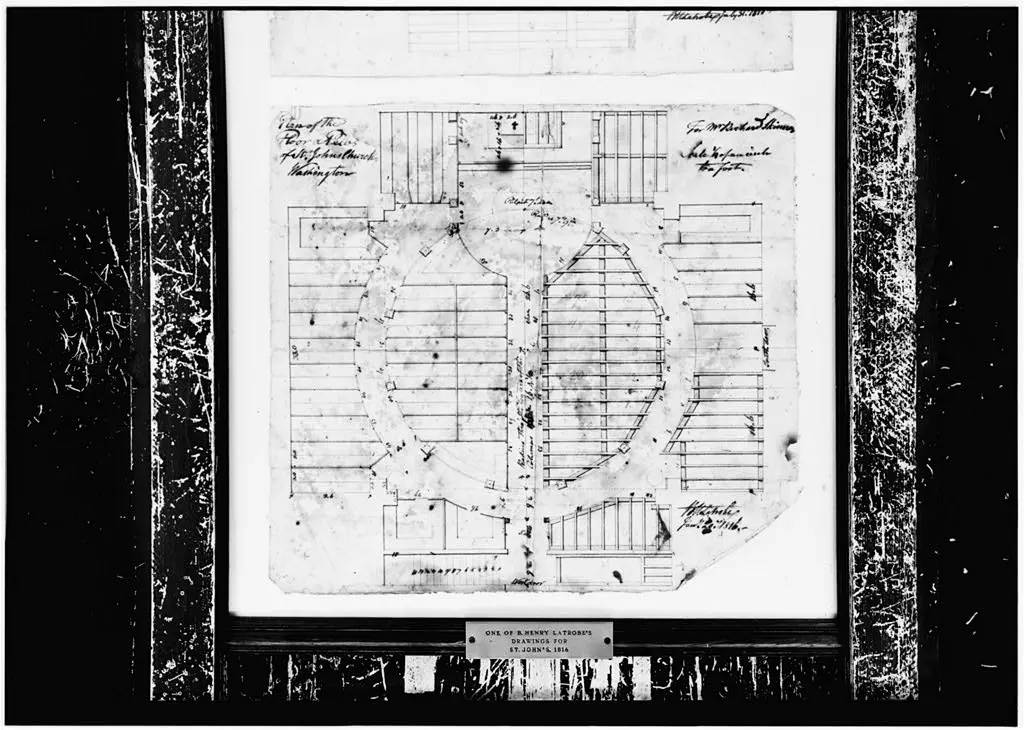
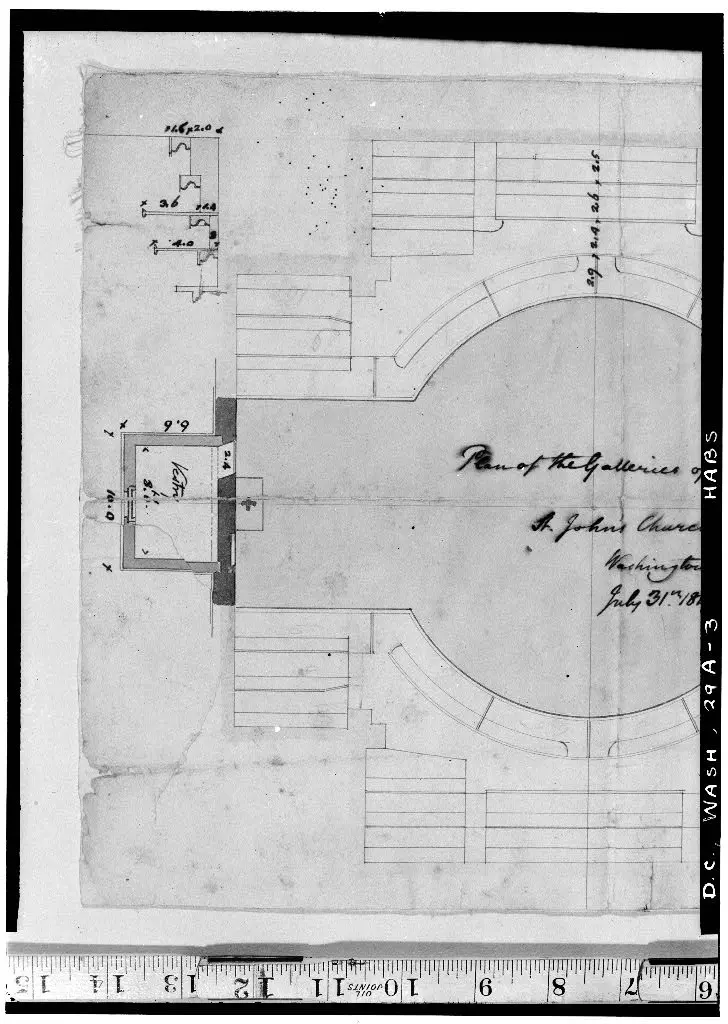
1816 Ground Plan
The cornerstone of St. John’s was set on September 14, 1815. St. John’s first service was held on October 27, 1816, and the church was consecrated on December 27, 1816.
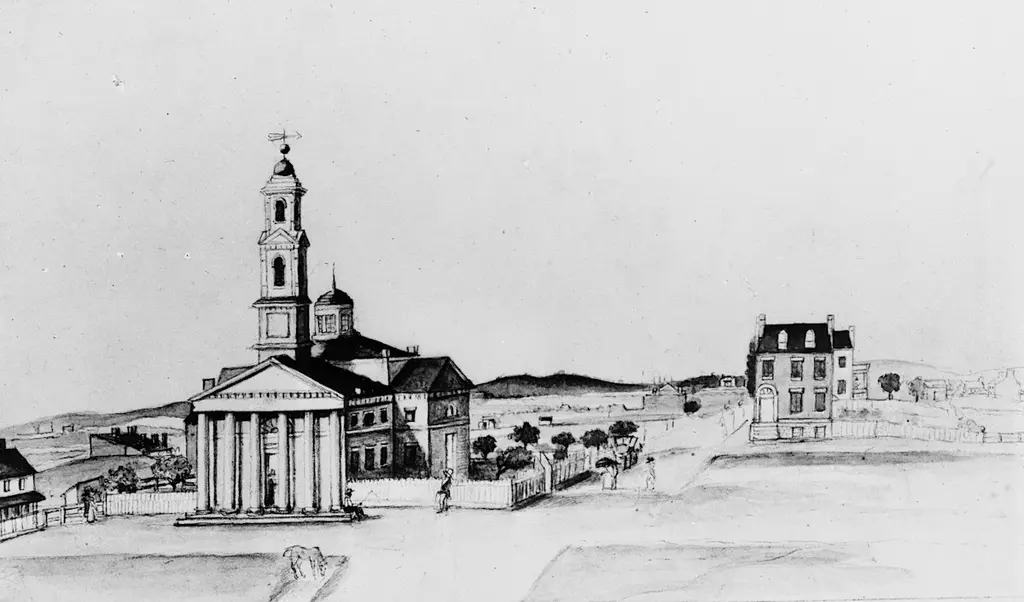
St. John’s and the Dolley Madison House
Baroness Hyde de Neuville's View of St. John's Church (1822)
This delicate watercolor, painted in 1822, offers one of the earliest surviving images of St. John's Church and its surroundings in Washington, D.C. The artist, Anne Marguérite Hyde de Neuville, sketched the scene from a third-floor window of Decatur House on Lafayette Square, capturing both the young church and the neighboring Richard Cutts House, later known as the Dolley Madison House.
The painter herself was a remarkable figure. Born Henriette Anne Marguérite Joséphine Rouillé de Marigny, she was a French aristocrat and self-taught watercolorist best known for documenting the people and landscapes she encountered during her years in early 19th-century America, leaving behind more than two hundred watercolors and drawings. She had fled France with her husband, Jean-Guillaume Hyde de Neuville, after the Revolution, and the couple lived in exile for several years before sailing for New York in 1807. After Napoleon's fall, the Baron returned to France only to be named French ambassador to the United States, bringing the couple back to Washington, where from 1821 to 1823 they rented Decatur House — placing the Baroness in the perfect vantage point to record the developing streets and buildings around the new capital's President's Neighborhood.
Her painting is more than a charming domestic sketch — it is a rare, eyewitness visual document of St. John's Church in its earliest years, painted by one of the first women artists in America to leave behind a substantial and historically significant body of work. The watercolor is held today in the collection of the New-York Historical Society.
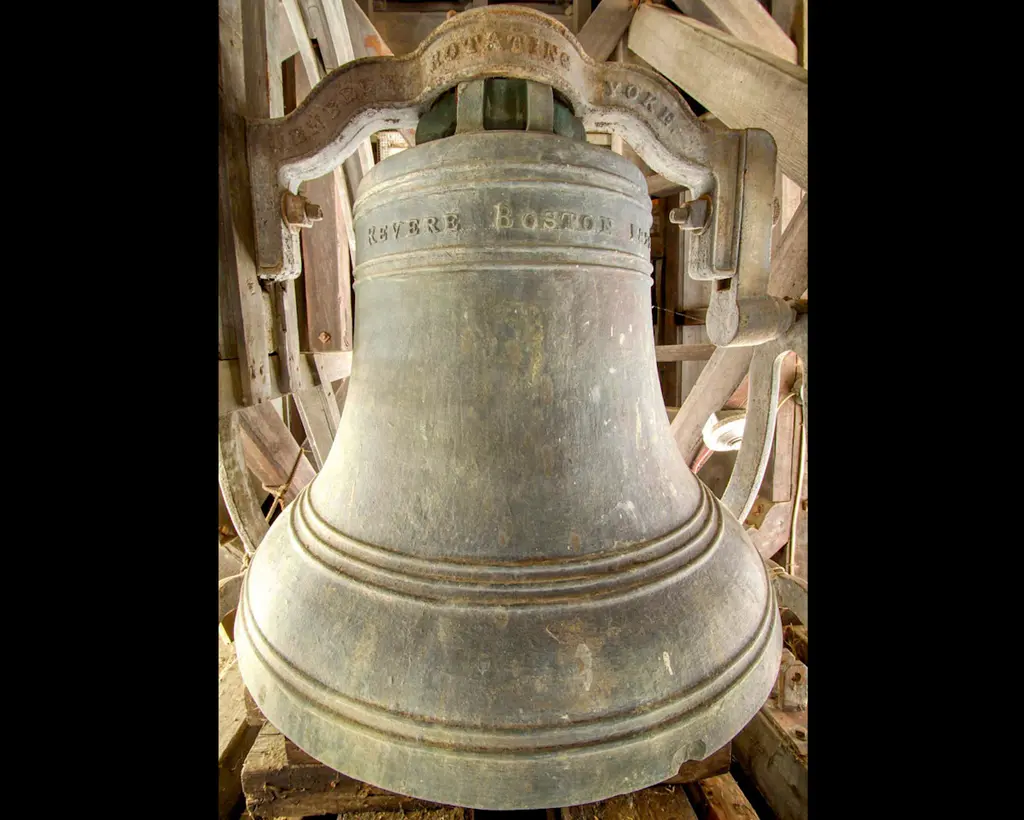
The Revere Bell
The Revere Bell, 1822
Hanging in St. John's bell tower since 1822, this nearly 1,000-pound bell carries one of the most storied names in American history. It was cast by Paul Revere's son, Joseph, at his Boston foundry in August 1822 and installed at St. John's that November 30. The bell cost $400, raised through parishioner donations and a $100 contribution of public funds personally authorized by President James Monroe.
The bell's role extended well beyond Sunday worship. It also served as an alarm bell for the surrounding neighborhood and nearby public buildings, including the White House itself. St. John's bell is one of two Revere bells in Washington, D.C., both cast and installed in 1822 — but it is the only one of the pair that has remained in continuous service since it was first hung.
More than two centuries later, the bell still rings out over Lafayette Square, having watched over the White House and its neighbors through war, fire, protest, and every presidential inauguration since — a rare and tangible link between St. John's, the Revere family's legacy of American craftsmanship, and the life of the capital itself.
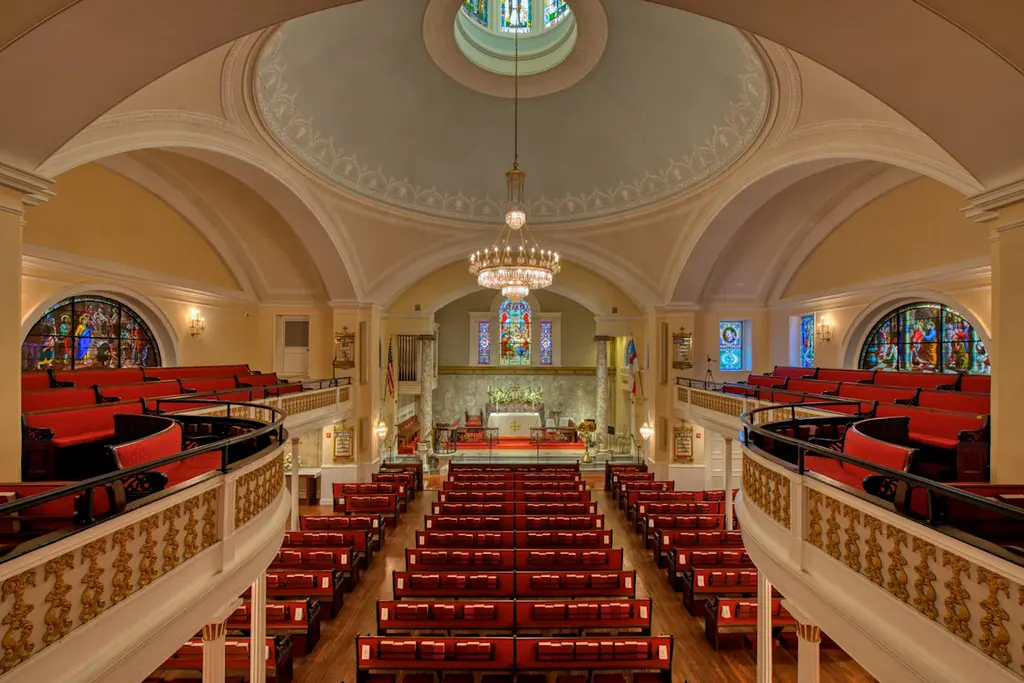
St. John’s Church Interior
The Interior of St. John's Church
Inside, St. John's retains the intimacy of Benjamin Henry Latrobe's original 1816 design even after two centuries of growth and renovation. Latrobe designed the church on a Greek cross plan with equal arms and a cupola, though later architects modified the structure into a Roman cross and added the portico and bell tower that visitors see today. The renovations of 1843 reshaped the worship space further, replacing the original boxed pews with the lower, open seating still in use.
The sanctuary is also illuminated by a set of 25 stained glass windows designed and produced in 1883 by the Lorin Stained Glass Windows firm of Chartres, France, filling the space with light even as its plain, dignified lines recall Latrobe's original Federal-era vision. Together, the architecture and furnishings make the interior a living record of two hundred years of American religious and civic life, gathered quietly within sight of the White House.
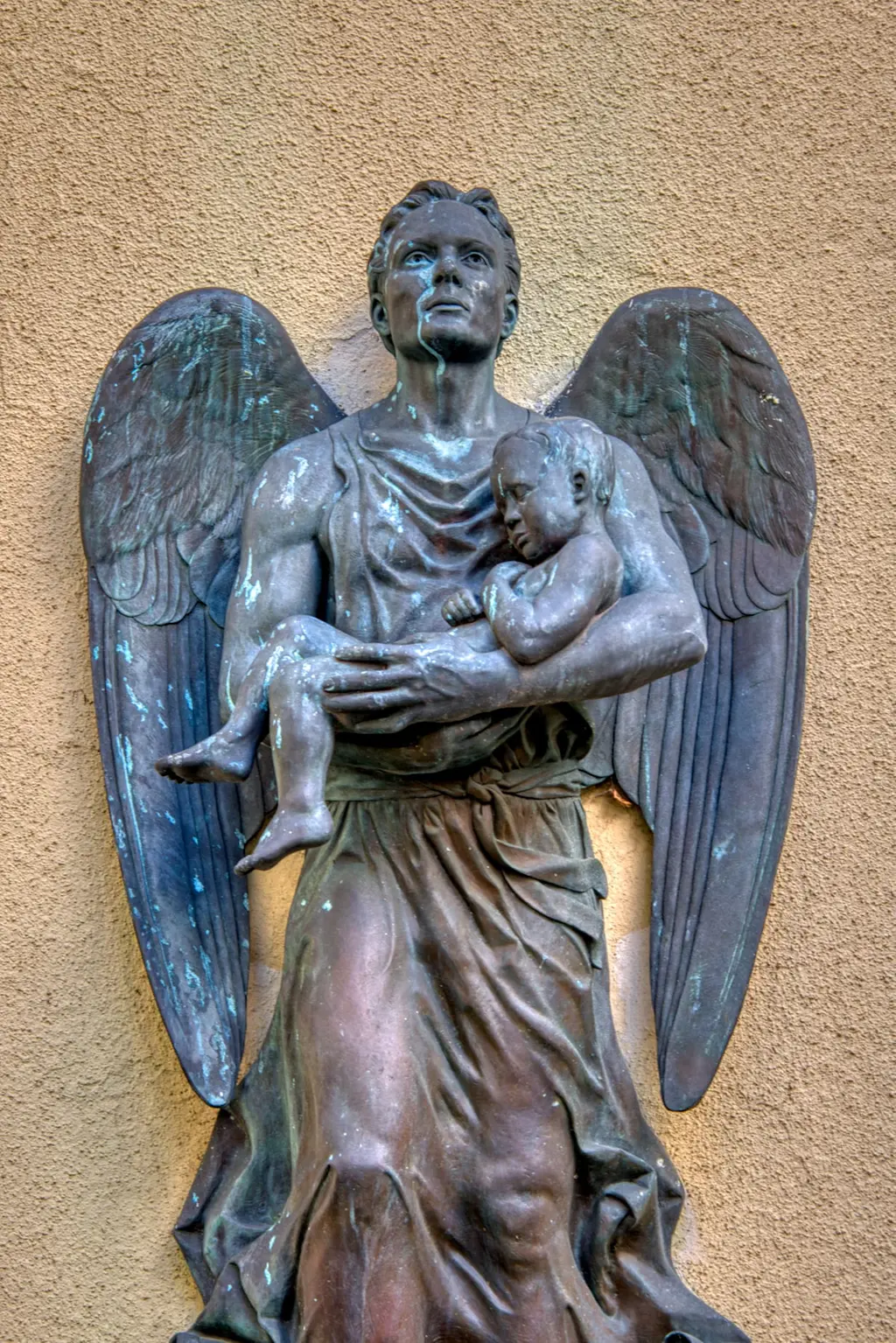
“Ascent into Heaven” by Jay Hall Carpenter
"Ascent into Heaven" by Jay Hall Carpenter
This bronze sculpture, set in St. John's columbarium, depicts an angel cradling a child as it rises heavenward. It is one of two sculptures by Jay Hall Carpenter in the church, a three-quarter life-size bronze of an angel and child overlooking the columbarium. The piece, cast in an edition of six, is meant to portray the soul's journey into heaven cradled in the comforting arms of an angel — an image of solace fitting for its placement in the space where parishioners' ashes are kept at rest.
The sculptor, Jay Hall Carpenter, is one of the most prolific liturgical artists working in America today. Born in 1961, Carpenter is perhaps best known as the creator of 500 sculptures for the Washington National Cathedral, with work also held by the State Department, the Smithsonian Institution, Canterbury Cathedral, and West Point Military Academy. He trained at the Pratt Institute and The Catholic University of America, and was elected to the National Sculpture Society before the age of thirty. Early in his career, he served as sculptor's assistant to master sculptor Frederick Hart on projects for the Washington National Cathedral and the Vietnam Veterans Memorial.
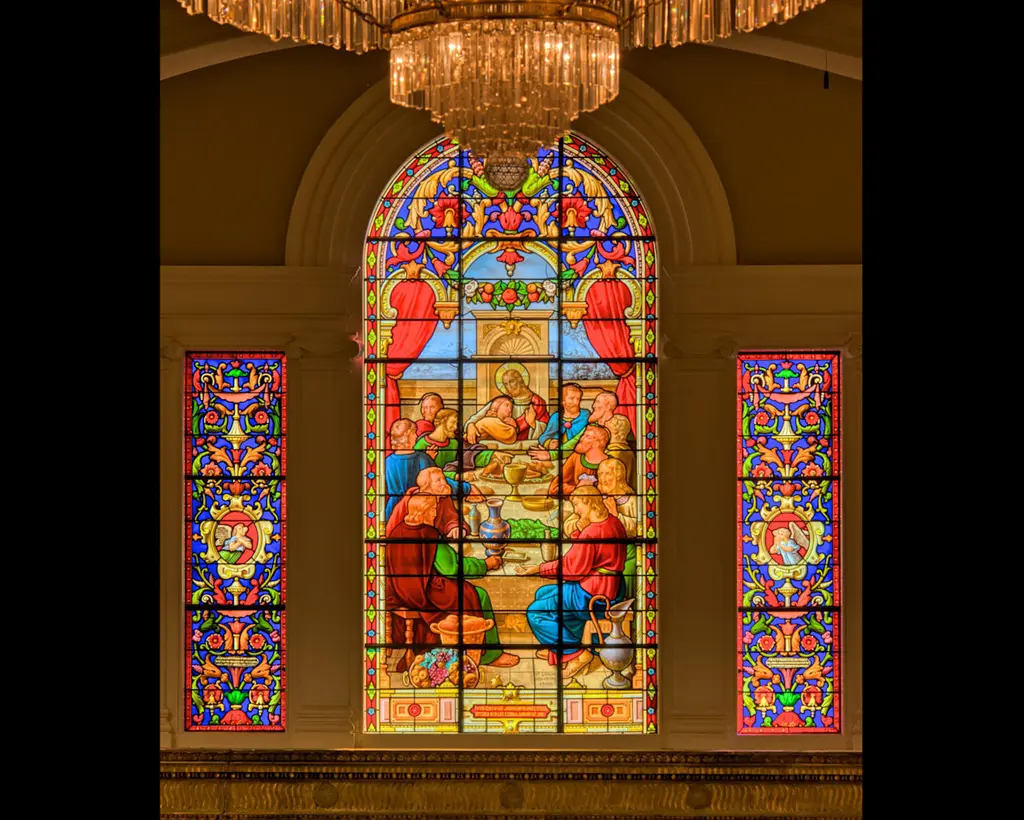
The Last Supper Window (Annie E. Steele Memorial Window)
St. John’s Church features 25 historic stained glass windows, designed and produced by the noted Lorin Stained Glass Windows firm Chartres, France. They were commissioned in 1883 and installed over a period of two years. They depict scenes from the life of Jesus and from the Gospel of St. John, for whom the church is named.
The central stained glass window over the altar is a unique rendition of the Last Supper. The disciples are seen on both sides of a long table, with Jesus the central figure at the far end, and St. John leaning on his shoulder. All the Lorin windows throughout the main floor and gallery are outstanding examples of this unique style from the late 19th century.
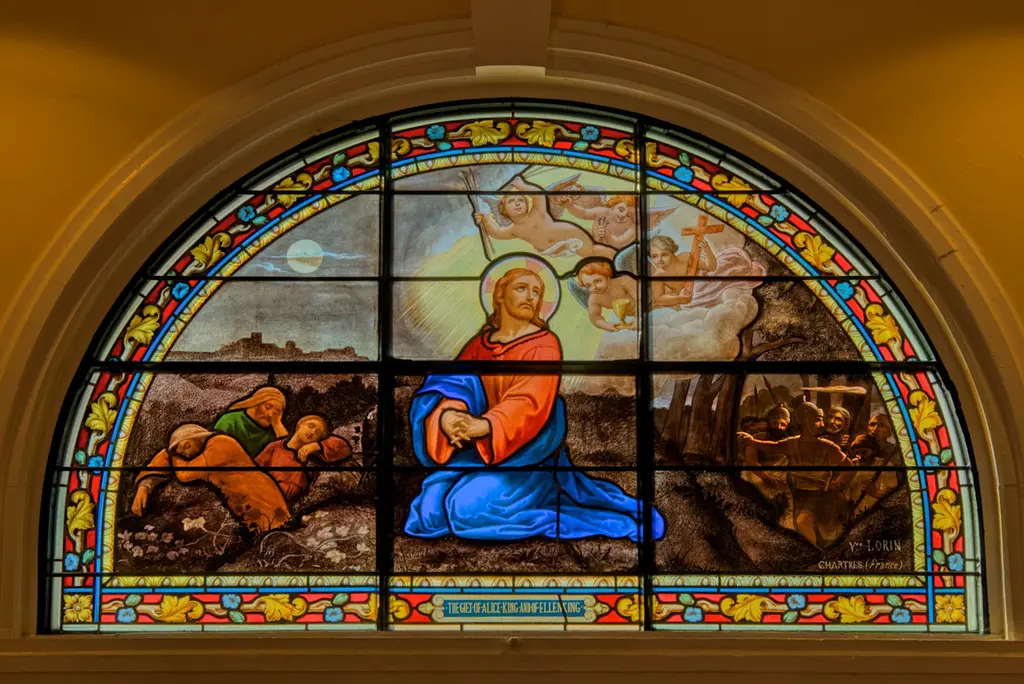
The Garden of Gethsemane Window (King Sisters Memorial Window)
St. John’s Church features 25 historic stained glass windows, designed and produced by the noted Lorin Stained Glass Windows firm Chartres, France. They were commissioned in 1883 and installed over a period of two years. They depict scenes from the life of Jesus and from the Gospel of St. John, for whom the church is named. All the Lorin windows throughout the main floor and gallery are outstanding examples of this unique style from the late 19th century.
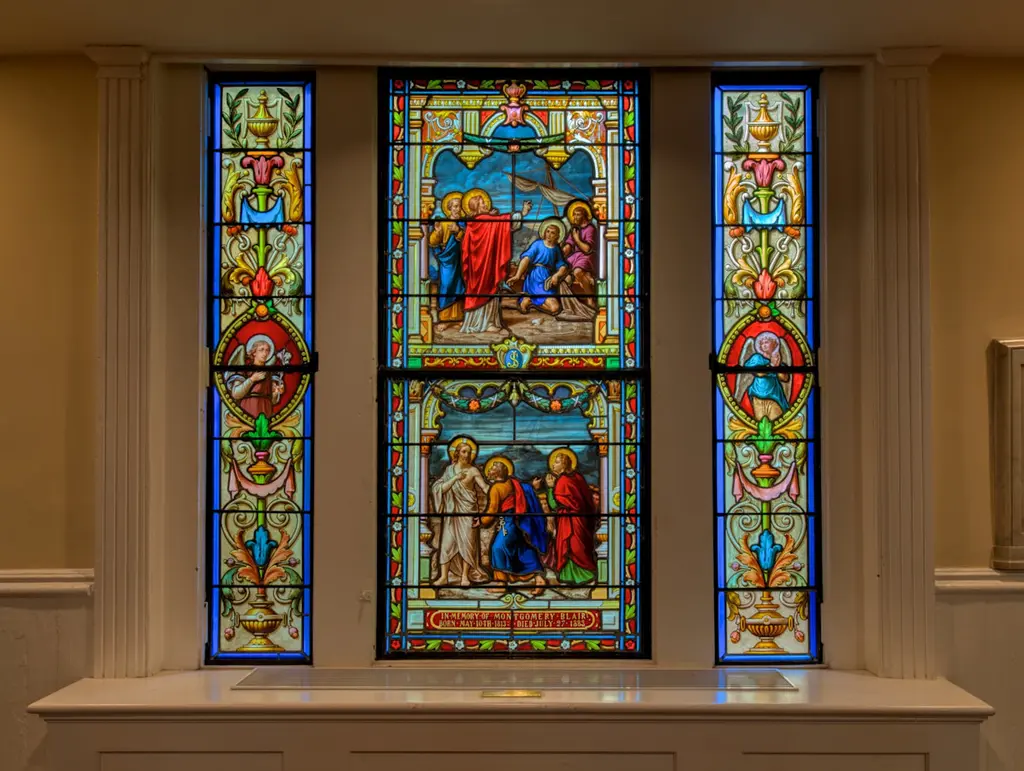
Montgomery Blair Memorial Window
The Calling of St. John and St. James (upper medallion); St. Peter asking Jesus about St. John’s mission (lower medallion); on AFL side of church opposite the President’s Window on H Street.
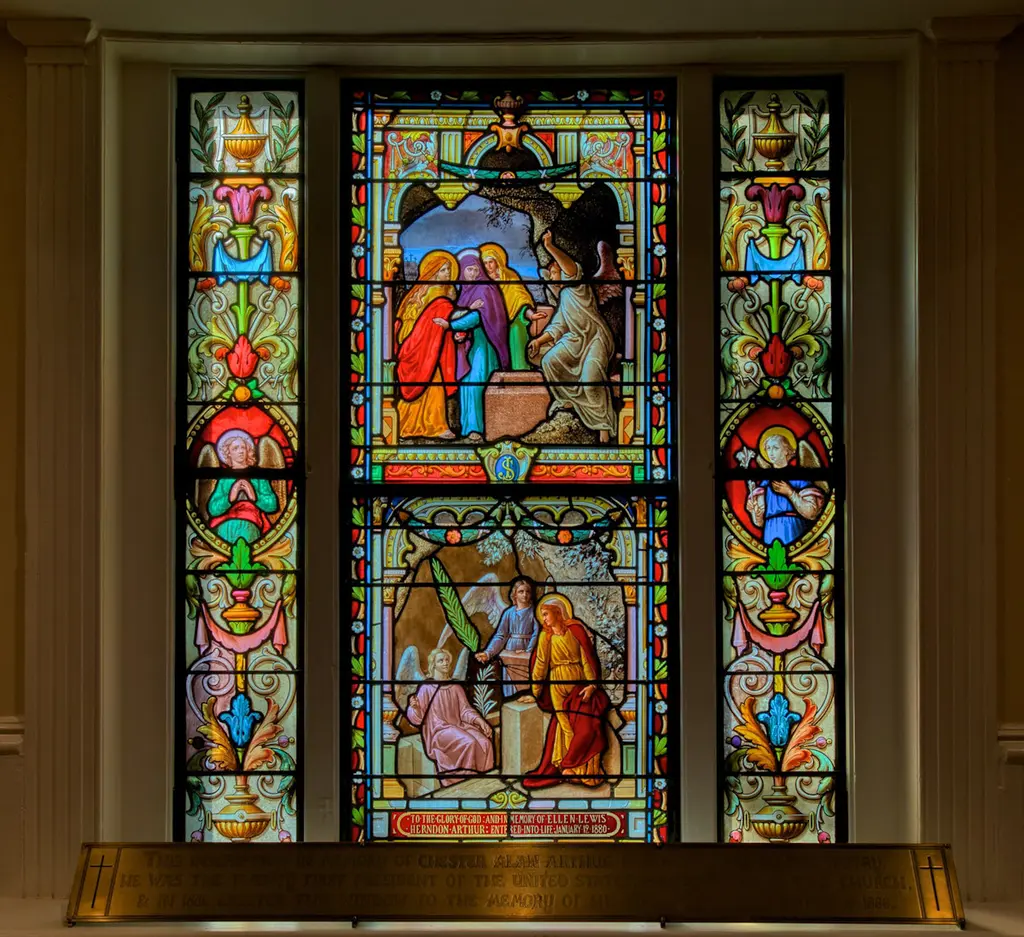
The Resurrection (Nell Arthur Memorial Window)
“…Ellen Herndon, who sang in St. John’s choir, met and fell in love with Chester Arthur at the church. The couple was married in New York City. Mrs. Arthur died in 1880 about the time Arthur was elected Vice-President. … [During his time as President,] Arthur presented a memorial window to the church which was placed in the south transept overlooking the White House.” Excerpt from “The Pew Where Lincoln Sat,” by the Washington Diocese, 1961.
For further reading, see whitehousehistory.org.